

Olicem’s DAHS system ReportLoq is highly flexible and is built for even complex needs.
The DAHS system itself is a software package installed on a Windows-based platform. In addition, there is an optional hardware package consisting of the following three individual elements:
- DAHS system – Data Aquisitioning and Handling System (DAHS) – Averaging and web server with user interface
- Data Collector – I/O box for data collection
- Support module – Encrypted connection between the equipment delivered to you and Olicem’s data center
There are many choices and combinations of the three elements, depending on your requirements for uptime, IT security, existing infrastructure and access to support.
The complete system is also called a DAHS (Data Acquisition and Handling System).
The DAHS system can also be upgraded to ReportLoq Cloud with connection via Olicem’s data center, providing additional data protection, easy user access and API access to calculated emission values according to EN 17255-1:2019
Put together your package
The three packages below are examples of how DAHS systems can be built. Depending on hardware requirements, current measurement equipment, protocols and uptime of the DAHS system, the packages can be modified to fit your exact needs. We therefore always recommend that you contact our specialists for a non-binding discussion about your needs.
All Reportoq DAHS solutions are basically self-supporting solutions without the need for internet. However, all solutions can be connected to the internet, making environmental data available via www.reportloq.com.
The DAHS system
The DAHS system itself runs on a Windows Server version or a Windows IoT Enterprise LTSC device.
The server used can be of the following types:
- Rack Server (Default: Dell)
- Virtual server (In existing data center)
- All-in-one module (Beckhoff CX2043)
The ReportLoq server is fully OPC-UA compliant and comes standard with OPC-UA server for displaying calculated values to control systems.
In addition to the ReportLoq DAHS server, forms of communication other than OPC-UA require a data collector, which Olicem tailors to the specific need.
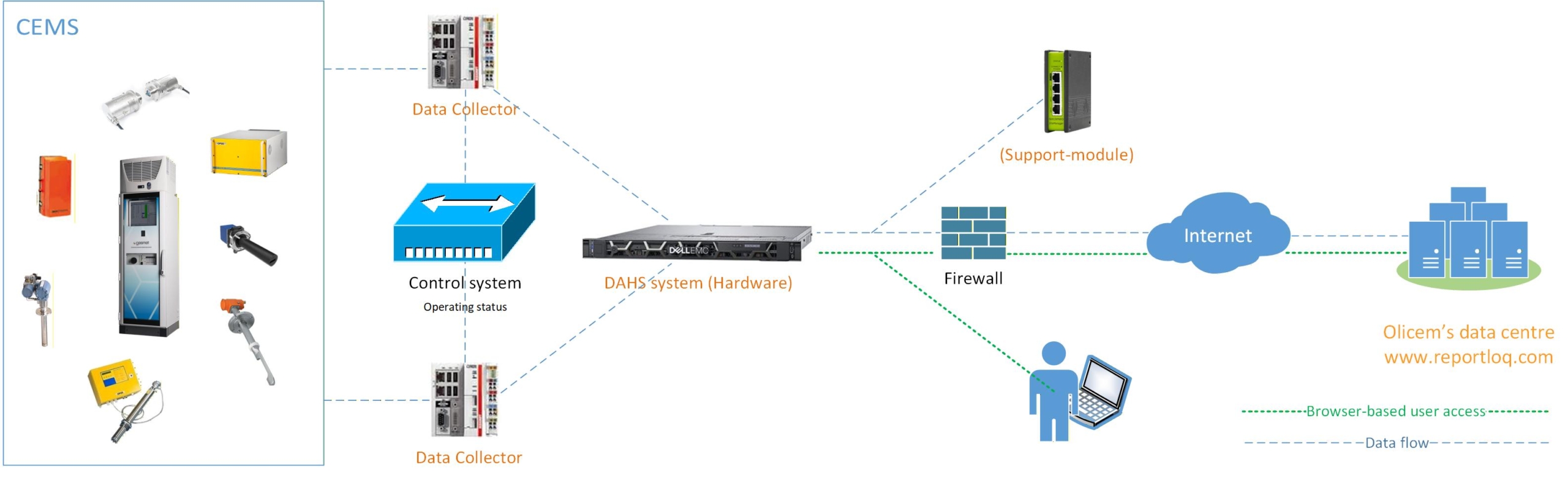
Package #1 – Rack Server
The included rack server comes with redundant disks with a hot spare (RAID 1+1). This means that you have an extra disk which quickly takes over in the event of a fault on one of the primary disks. The server also has redundant power supplies.

The rack server in the package is supplemented with redundant data collectors to prevent data loss even if the DAHS system or one data collector breaks down.
Advantages: Redundancy on data collectors and the hardware that most often fails in a server.
Package #2 – Virtual Server
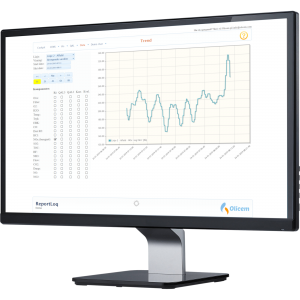
When choosing a virtual server, ReportLoq is installed in an existing data center.
Minimum requirements for virtual server:
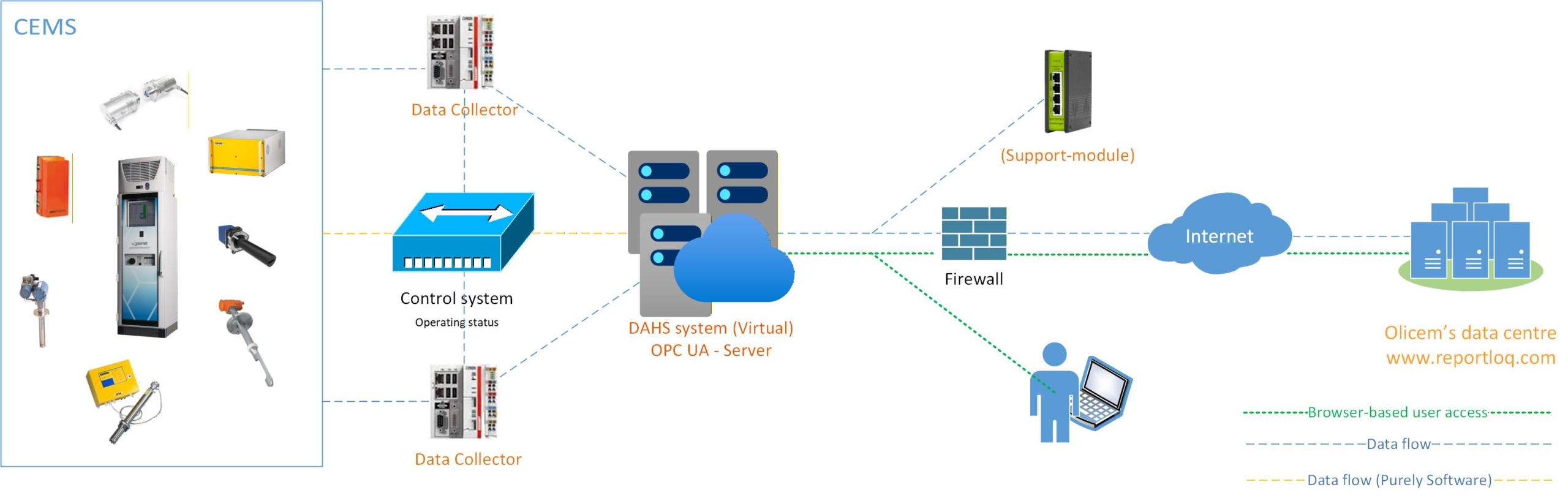
Two possible solutions are shown in the package.
- Solution 1 (Software only)
The control system is responsible for sending read data from all metering systems to the DAHS system. This creates a completely hardware-free solution.
Advantages: The entire DAHS system can be run on an existing infrastructure. There are no additional hardware maintenance costs.
Cons: Data loss is to be expected during maintenance of the DAHS system, as there are no external data buffers in the system. - Solution 2 (With data collectors)
The virtual server is flanked by one or more data collectors. The data collectors are industrial devices with a very high uptime and data buffering.
Benefits: Data is collected during DAHS updates. This prevents the risk of gaps in the dataset during maintenance.
Cons: Additional costs for installation and maintenance. However, the lifespan of a Data Collector is expected to be +10 years.
Benefits of a virtual server: Ability to use existing data center with patching, backup, failover and monitoring.
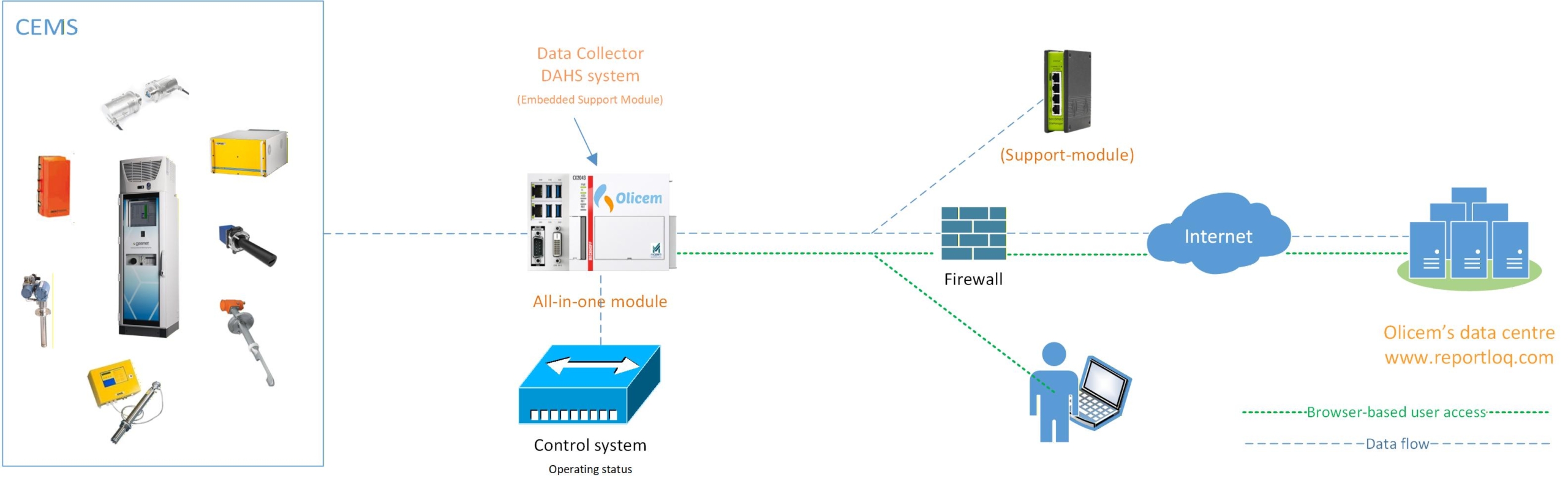
Package #3 – All-in-one module
The Beckhoff CX2043 IPC is an Industrial PC that combines the ReportLoq server with the data collector in one piece of hardware.
Advantages : Lower price due to less hardware. Easy to use on installations without server space, as IPC sits directly in the board with equipment.

Collect data
In EN 17255-2:2020 (6.2.4) the data collector is described as “Remote Data Logger Unit”. The unit is approved to collect data close to the source and ensures that data is logged even if the DAHS system is taken out for maintenance.
The Data Collector can be connected to the CEMS (Continuous Emission Monitoring Systems) and the control system. IT is responsible for the collection of all environmental data. It is recommended to place the Data Collector close to the source of data to minimize the risk of possible data loss due to wirebreak. The Data Collector has data stored for 30 days and has the task of collecting data and acting as a link between CEMS and the control system.
The data collector is a Beckhoff CX5130 and comes pre-installed with ReportLoq software built for data collection and exchange of data with control systems. Supported protocols include Profibus, Profinet, Modbus, Hardwired 4-20, OPC UA, Ethernet TCP.
Note that Olicem’s All-in-One device includes an embedded data collector, and thus also collects data when the DAHS system is updated.
Redundancy
The highest level of security is achieved with two data collectors. This does not interrupt data collection if one device shuts down.

ReportLoq Cloud
All versions of ReportLoq can be upgraded with Cloud access. The solution ensures both easy user access to emission data and backup in Olicem’s Data Center at the same time.
The connection to https://www.reportloq.com is based on the Open API 3.0 standard and uses an asymmetric login and encryption of the transferred data. The connection is easy and is based on a PIN code that establishes the connection between the two systems.
If you are an IT security specialist, simply open port 443 to www.reportloq.com. Communication is then based on Let’s Encypt SSL certificates, JWT tokens and REST-based endpoints. DAHS contains all the necessary components for the interconnection. Via the solution, the DAHS system uploads logged data to the cloud and simultaneously downloads user-entered values to the local server.
Note that it is never recommended to expose the web interface from the local DAHS system on the internet. All incoming ports in the firewall should be closed. Users accessing the DAHS system via www.reportloq.com do not log on to the local server, thus securing internet users from the company’s local network.
Data retention
Both in Olicem’s Data Center and in the local DAHS system, data is usually stored for 5 – 10 years. This means that with the cloud, you always have your full data set in at least two places. Additional security can be achieved with a local daily backup, virtual server solutions and redundant server disks. The local backup can be further copied to an internal FTP server if desired.
API solution
If you have a BI solution, a need for pre-calculated values or want to visualize your emitted mass emissions on a dashboard, our API is just right for you. The API offers raw values, pre-calculated hourly, daily, monthly and annual values as well as lists of exceedances and events. Naturally, the API is accompanied by a comprehensive Olice manual with explanations of the API’s many data types.
The Swagger-based API solution is based on OpenAPI 3.o and is accessed via https://www.reportloq.com/api/swagger-ui/. Access is secured via API keys and can be locked to your fixed IP address.
Support module
If you want easy access to remote support and assistance on your local ReportLoq installation, you can opt for a secure support and connectivity module.
The module enables our support team to provide direct assistance, perform maintenance and install software updates remotely.
It is not required for the operation of ReportLoq. You only select it if you want this option.
Secure and easy connection
The solution is based on a Secomea SiteManager, which establishes an encrypted tunnel to Olicem’s support environment.
Only one outgoing connection via TCP port 443 is needed, so the module is easy to deploy – even in environments with high security requirements.
Hardware or software
You can choose between:
-
Hardware SiteManager, or
-
Embedded software version, installed directly on the DAHS server
Both options provide a flexible and reliable deployment.

Secure environmental reporting
We specialize in delivering high quality in complex environments